
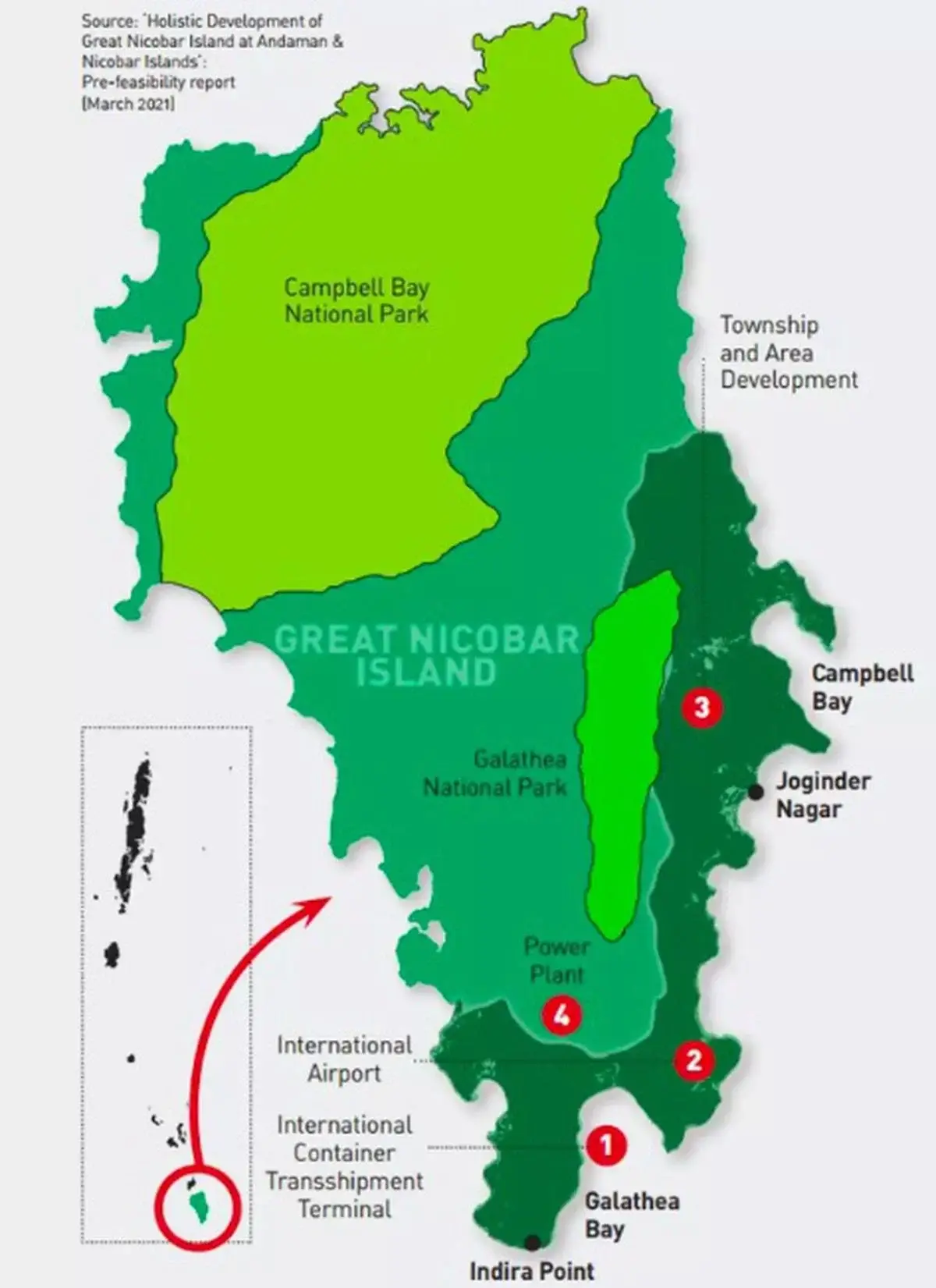
The Great Nicobar Island (GNI) Project is a mega-infrastructure and economic development initiative conceptualized by NITI Aayog to transform the island into a strategic hub for commerce, transport, and defence.1 Implemented by the Andaman and Nicobar Islands Integrated Development Corporation (ANIIDCO), the project is a cornerstone of India’s Maritime Vision 2030 and a key component of the Amrit Kaal Vision 2047.2
The project involves four primary components:3
-
An International Container Transshipment Terminal (ICTT).
-
A greenfield international airport with dual-use (civilian and military) capabilities.4
-
A modern, integrated township.
-
A gas and solar-based power plant.
Strategic Significance of the GNI Project
The project’s importance is multifaceted, spanning economic, geopolitical, and security domains.5
-
Economic Hub and Transshipment: The ICTT is designed to make India a major player in global maritime trade. By providing a deep-water transshipment facility, it will reduce the reliance of Indian cargo on foreign ports like Colombo, Port Klang, and Singapore, saving significant logistics costs and integrating India more deeply into global supply chains.6
-
Geopolitical Positioning: Great Nicobar’s location is its greatest asset.
-
It lies in close proximity to the Strait of Malacca, one of the world’s most critical sea lanes of communication (SLOCs) through which a majority of global trade and energy supplies pass.7
-
This strategic positioning allows India to enhance its maritime domain awareness and monitor naval movements in the Indo-Pacific region, particularly in the context of China’s increasing presence.8
-
Its proximity to important regional locations like Sabang Port (Indonesia) and the proposed Kra Canal (Thailand) further solidifies its role as a pivotal point in regional maritime routes.9
-
-
Maritime Security Enhancement: The Andaman & Nicobar archipelago serves as India’s “unsinkable aircraft carrier” in the Indian Ocean.10
-
The project will bolster India’s naval capabilities and power projection in the IOR, strengthening its ability to counter piracy, illegal trafficking, and terrorism.11
-
It reinforces India’s role as a net security provider in the region and aligns with key foreign policy initiatives like the ‘Act East’ Policy and its strategic commitments under the QUAD framework.12
-
The islands provide India with a vast Exclusive Economic Zone (EEZ) as defined by the UNCLOS, 1982.13
-
Safeguards and Mitigation Measures
The government has emphasized that the project’s execution is contingent upon robust safeguards for both the indigenous tribal populations and the island’s fragile ecology.
-
Tribal Welfare Safeguards: The project adheres to strict protocols to protect the Particularly Vulnerable Tribal Groups (PVTGs), primarily the Shompen and Jarawa communities.
-
Development is guided by the Jarawa Policy (2004) and the Shompen Policy (2015).
-
Mandatory consultations with the National Commission for Scheduled Tribes (NCST), as required under Article 338A(9) of the Constitution, have been conducted to ensure tribal interests are protected.14 The Andaman Adim Janjati Vikas Samiti (AAJVS) acts as a trustee to safeguard the welfare of these communities.15
-
-
Environmental Safeguards: An Environmental Management Plan (EMP), formulated after a detailed Environmental Impact Assessment (EIA), is central to the project’s design.16
-
To mitigate habitat fragmentation, eight wildlife corridors are planned to ensure the safe movement of arboreal and terrestrial fauna.
-
To compensate for the loss of forest cover, compensatory afforestation is planned in Haryana.17 This unique step was taken because the Andaman & Nicobar Islands already have a forest cover exceeding 75%, making large-scale afforestation on the islands unfeasible.
-
Conclusion
The Great Nicobar Island Project represents a paradigm shift in India’s approach to maritime strategy, aiming to create an economic powerhouse that also serves its security interests.18 While concerns regarding its ecological and social impact are significant, the project incorporates a framework of safeguards to balance development with conservation and tribal welfare.19 If implemented successfully, the GNI project has the potential to fundamentally enhance India’s economic resilience and strategic footing in the critical Indo-Pacific region.
UPSC Civil Services Examination, Previous Year Question (PYQ)
Prelims
Q. Consider the following statements: (2018)
The Barren Island volcano is an active volcano located in the Indian territory.
Barren Island lies about 140 km east of Great Nicobar.
The last time the Barren Island volcano erupted was in 1991 and it has remained inactive since then.
Which of the statements given above is/are correct?
(a) 1 only
(b) 2 and 3
(c) 3 only
(d) 1 and 3
Ans: (a)
Q. Which one of the following pairs of islands is separated from each other by the ‘Ten Degree Channel’? (2014)
(a) Andaman and Nicobar
(b) Nicobar and Sumatra
(c) Maldives and Lakshadweep
(d) Sumatra and Java
Ans: (a)
Mains
Q. Environmental impact assessment studies are increasingly undertaken before the project is cleared by the government. Discuss the environmental impacts of coal- fired thermal plants located at Pitheads.(2023)