
Syllabus Mapping:
-
GS Paper 2: Indian Constitution, Government Policies and Interventions, Welfare Schemes for Vulnerable Sections, Mechanisms, Laws, Institutions and Bodies constituted for the Protection and Betterment of these Vulnerable Sections.
Context:
Recent political discourse, including proposals to increase reservation quotas beyond 50% in states like Bihar, and judicial inquiries by the Supreme Court into the applicability of the ‘creamy layer’ concept to Scheduled Castes (SCs) and Scheduled Tribes (STs), have reignited the debate surrounding India’s reservation policy. These developments challenge the judicially mandated 50% ceiling and raise critical questions about the equitable distribution of affirmative action benefits among marginalised communities.
Understanding Reservation in India
Reservation is a form of positive discrimination or affirmative action designed to address historical and social injustices. It provides preferential treatment in public education and employment to uplift and ensure adequate representation for disadvantaged communities, thereby promoting substantive equality.
-
Current Central Quota:
-
Other Backward Classes (OBCs): 27%
-
Scheduled Castes (SCs): 15%
-
Scheduled Tribes (STs): 7.5%
-
Economically Weaker Sections (EWS): 10%
-
This totals 59.5% at the central level, with states having varying quotas based on their demographic composition.
-
Constitutional Provisions for Reservation
The framework for reservation is enshrined in the Constitution of India, primarily under Part III (Fundamental Rights) and Part XVI (Special Provisions Relating to Certain Classes).
Part III: Fundamental Rights
-
Article 15(3): Enables the State to make special provisions for women and children.
-
Article 15(4): Empowers the State to create special provisions for the advancement of any socially and educationally backward classes (SEBCs), including SCs and STs.
-
Article 15(5): Allows reservations for SEBCs, SCs, and STs in educational institutions (public and private), except minority educational institutions.
-
Article 15(6): Introduced by the 103rd Amendment Act, 2019, it allows for up to 10% reservation for Economically Weaker Sections (EWS).
-
Article 16(4): Permits the State to reserve appointments or posts for any backward class of citizens not adequately represented in public services.
-
Article 16(4A): Provides for reservation in promotions with consequential seniority for SCs and STs (77th and 85th Amendments).
-
Article 16(4B): Allows the carry-forward of unfilled reserved vacancies, delinking them from the 50% ceiling for that year (81st Amendment).
-
Article 16(6): Provides for up to 10% reservation for EWS in public employment.
Part XVI: Special Provisions
-
Articles 330 & 332: Mandate reservation of seats for SCs and STs in the Lok Sabha and State Legislative Assemblies, respectively.
-
Articles 243D & 233T: Mandate reservation for SCs and STs in Panchayats and Municipalities, respectively.
-
Article 335: Stipulates that the claims of SCs and STs to public services shall be considered, consistent with maintaining administrative efficiency.
Key Judicial Pronouncements Shaping Reservation Policy
-
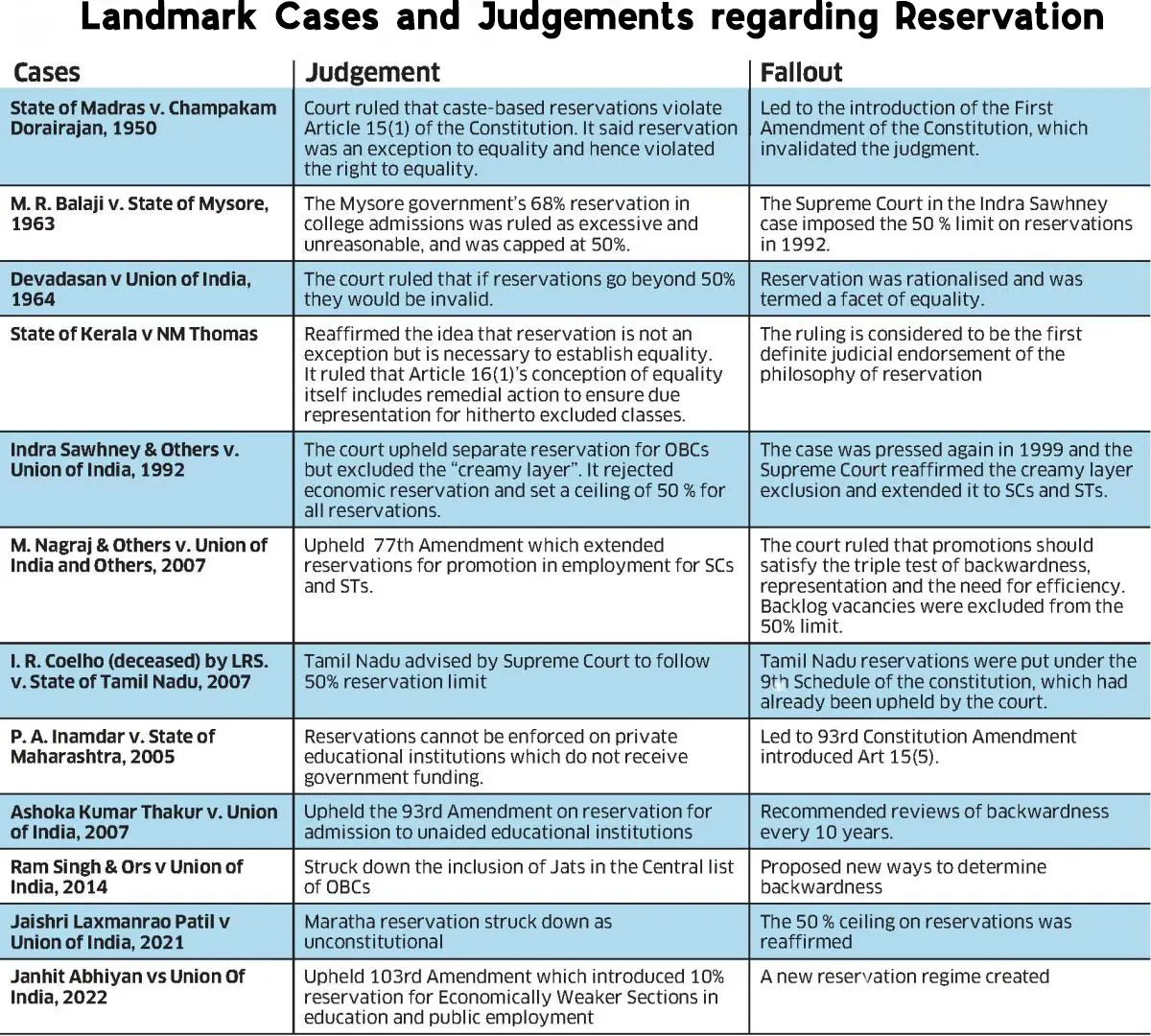
M.R. Balaji vs. State of Mysore (1962): The Supreme Court capped reservations at 50%, ruling that they were an “exception” to the principle of equality and should be reasonable.
-
State of Kerala vs. N.M. Thomas (1975): The Court introduced the concept of ‘substantive equality’, holding that reservations are not an exception to, but a facet of, equality of opportunity.
-
Indra Sawhney & Ors. vs. Union of India (1992):
-
The “Mandal Case” upheld the 50% ceiling on reservations as a rule to maintain a balance between merit and social justice.
-
It permitted breaching the cap only in “extraordinary situations” and remote areas.
-
It also institutionalised the ‘creamy layer’ concept, mandating the exclusion of the advanced sections among OBCs.
-
-
State of Punjab vs. Davinder Singh (2020): The Supreme Court revisited the issue of sub-categorisation within SCs and STs to ensure benefits reach the most marginalised, suggesting the application of the creamy layer principle.
The Debate on Exceeding the 50% Reservation Cap
| Arguments in Favour of Breaching the Cap | Arguments Against Breaching the Cap |
| Proportional Representation: Proponents argue that since reserved categories (SC, ST, OBC) constitute over 60% of the population, the 50% cap is arbitrary and denies proportional representation. | Constitutional Balance: The Supreme Court in the Indra Sawhney case established the 50% limit to balance the fundamental right to equality (Article 14) with the state’s welfare objectives. |
| Addressing Intra-Group Disparities: The Rohini Commission’s findings (97% of OBC benefits cornered by 25% of sub-castes) suggest that increasing the quota, combined with sub-categorisation, can ensure a more equitable distribution of benefits. | Implementation Gaps: A significant percentage (40-50%) of reserved seats remain vacant. Merely increasing the quota without addressing these administrative failures may not yield desired outcomes. |
| Principle of Substantive Equality: Following the N.M. Thomas case, if reservation is an extension of equality, a numerical cap is seen as a hindrance to achieving true social justice for all marginalised groups. | Risk to Administrative Efficiency: As cautioned by Article 335, excessive reservation could be perceived as sidelining merit, potentially compromising administrative efficiency and governance standards. |
| State-Level Precedents: States like Tamil Nadu have implemented reservations exceeding 50% (currently 69%), justifying it based on their unique social demographics. | Perpetuating Intra-Caste Inequality: Without applying the creamy layer principle to all reserved categories, expanding quotas could allow the more affluent sections within SCs/STs to monopolise benefits, defeating the purpose of reservation. |
The Way Forward: Towards Effective and Equitable Implementation
-
Data-Driven Policy: Conduct a comprehensive socio-economic caste census to gather accurate, up-to-date data on the population and status of various communities. This will provide an empirical basis for re-evaluating reservation policies.
-
Equitable Distribution Mechanisms:
-
Implement the Rohini Commission’s recommendations for the sub-categorisation of OBCs.
-
Initiate a constitutional debate on the application of the creamy layer principle to SCs and STs to ensure benefits percolate to the most deserving.
-
-
Strengthening Implementation: Launch special recruitment drives to fill the backlog of vacant reserved posts. Improve administrative capacity to ensure policies are implemented effectively on the ground.
-
Holistic Empowerment: Complement reservation with investments in quality education, skill development, and entrepreneurship support for marginalised communities. This creates a broader ecosystem of opportunity beyond government jobs.
Conclusion
The ongoing debate on reservation navigates the complex terrain between formal equality (treating everyone the same) and substantive equality (providing differential treatment to correct historical wrongs). While breaching the 50% ceiling is a constitutionally sensitive matter, it reflects the persistent demands for greater social inclusion. The future of reservation policy must be guided by empirical data, judicial prudence, and a commitment to equitable distribution through mechanisms like sub-categorisation. The ultimate goal remains the creation of a truly egalitarian society where affirmative action becomes a transitional tool rather than a permanent feature
UPSC previous years questions
Prelims
Q. Consider the following organizations/bodies in India: (2023)
- The National Commission for Backward Classes
- The National Human Rights Commission
- The National Law Commission
- The National Consumer Disputes Redressal Commission
How many of the above constitutional bodies?
(a) Only one
(b) Only two
(c) Only three
(d) All four
Ans: (a)
Mains:
Q. What are the two major legal initiatives by the State since Independence addressing discrimination against Scheduled Tribes (STs). (2017)