
Syllabus Mapping:
-
GS Paper 2: Bilateral, Regional and Global Groupings and Agreements involving India and/or affecting India’s interests; Effect of Policies and Politics of Developed and Developing Countries on India’s interests.
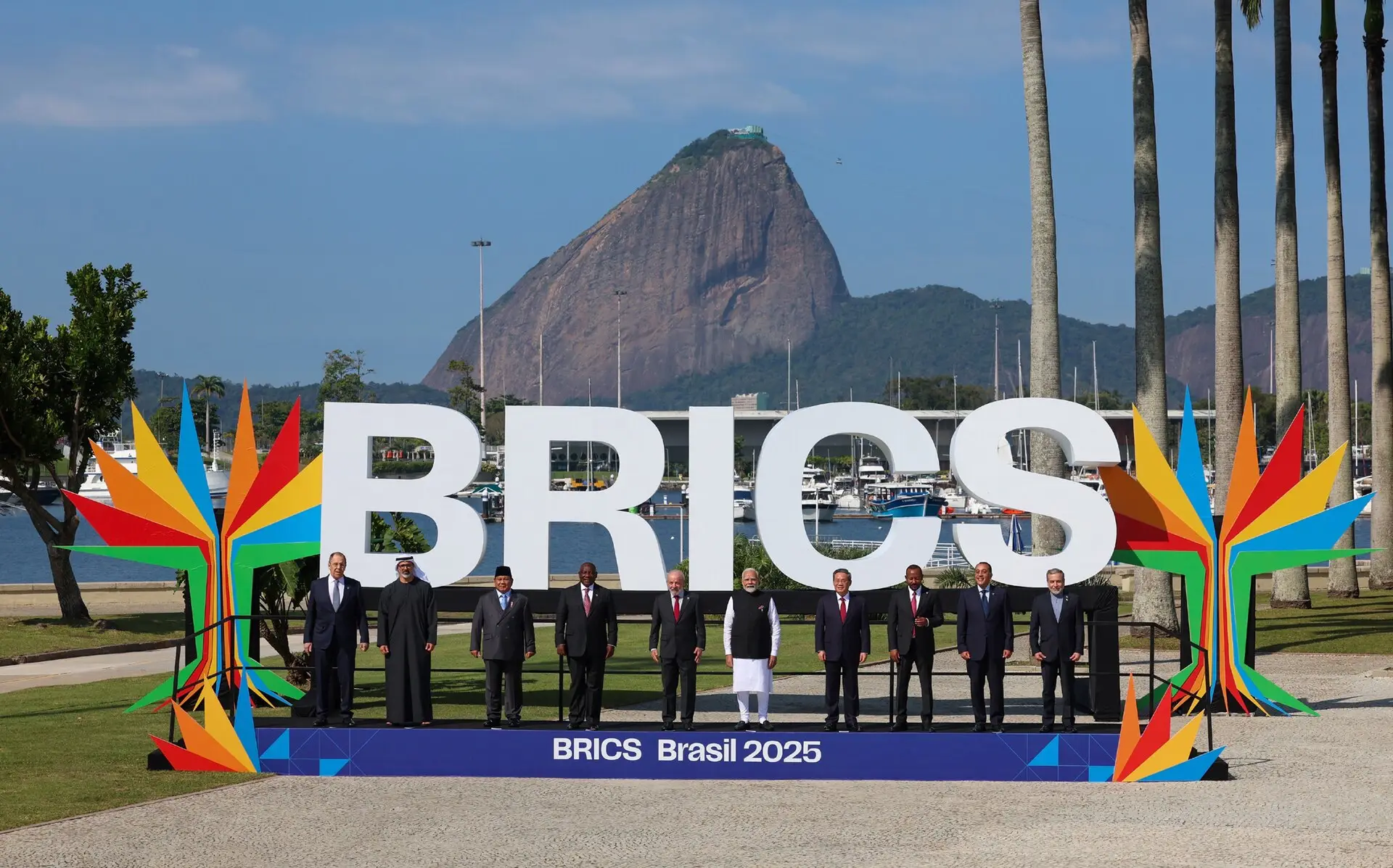
Context: At a recent BRICS summit, India’s External Affairs Minister highlighted the need to delink trade from political issues, cautioning against protectionist measures. This statement, made amidst global trade frictions and supply chain disruptions, underscores the growing importance of platforms like BRICS for safeguarding India’s geoeconomic interests in an increasingly volatile world.
About the BRICS Grouping
BRICS is an intergovernmental organisation comprising major emerging economies, originally formed to enhance economic cooperation and reform global governance.
-
Origin: The term “BRIC” was coined in 2001 by economist Jim O’Neill. The first formal summit was held in 2009. South Africa was invited to join in 2010, creating the “BRICS” acronym (Brazil, Russia, India, China, South Africa).
-
Expansion: The grouping has recently expanded to include Egypt, Ethiopia, Iran, Saudi Arabia, and the UAE, a development often referred to as “BRICS+”.
-
Core Objectives:
-
Promote Economic Cooperation: Enhance trade, investment, and financial integration among member nations.
-
Counterbalance Western Dominance: Advocate for a more equitable, multipolar world order and push for reforms in institutions like the UN, IMF, and World Bank.
-
Build an Alternative Financial Architecture: Reduce dependency on the US dollar and Western financial systems through institutions like the New Development Bank (NDB) and the Contingent Reserve Arrangement (CRA).
-
BRICS as a Geoeconomic Cushion for India
BRICS offers India a crucial platform to mitigate risks arising from global economic and political shocks.
-
Alternative Financial Architecture: The NDB provides financing for infrastructure without the stringent conditionalities often imposed by Western-led institutions.
-
Example: The NDB has approved nearly USD 10 billion for 28 projects in India, including the Delhi-Meerut Rapid Transit System and various metro projects, enhancing India’s bargaining power with Bretton Woods institutions.
-
-
Energy and Resource Security: The grouping includes major energy producers (Russia, Saudi Arabia, UAE) and consumers (China, India), creating a natural synergy.
-
Example: Post the Ukraine conflict, India secured discounted crude oil from Russia, which helped manage inflation and the trade deficit.
-
-
Promoting Local Currency Trade (De-dollarisation): By encouraging trade settlement in national currencies, BRICS helps shield India from US dollar volatility and the risk of sanctions.
-
Example: India and Russia are working to increase bilateral trade using national currencies, aiming to bypass payment systems like SWIFT.
-
-
Diversified Market Access: With the expanded BRICS accounting for over 40% of the global economy (by PPP), the bloc serves as a vital market buffer when Western economies face slowdowns. This provides steady demand for Indian exports like pharmaceuticals, agricultural products, and IT services.
-
Technology and Digital Cooperation: In an era of “tech-sanctions,” BRICS fosters collaboration in critical areas like AI, 5G, and fintech, helping create alternative technological ecosystems and reducing dependence on the West.
-
Food and Fertilizer Security: BRICS provides a safety net against disruptions in global food and fertilizer supply chains. Russia, a major fertilizer exporter, is a key partner in ensuring the stability of India’s agricultural sector.
Challenges and Constraints for India within BRICS
Despite its potential, India faces several significant challenges in leveraging the BRICS platform effectively.
-
China’s Overarching Influence: China’s economy is nearly five times larger than India’s, allowing it to dominate the BRICS agenda. Lingering border tensions (e.g., Galwan clash) and China’s opposition to India’s UNSC permanent membership bid erode mutual trust.
-
Divergence in Strategic Interests: Member states have conflicting foreign policy alignments. While China and Russia actively challenge the West, India pursues strategic autonomy, maintaining strong partnerships with the US, EU, and the Quad. This makes consensus-building difficult.
-
Weak Institutional Framework: Unlike the EU or ASEAN, BRICS lacks a permanent secretariat or binding enforcement mechanisms. Many initiatives, including the CRA, remain underutilised, limiting the group’s ability to act decisively during a crisis.
-
Slow Progress on Key Initiatives: The push for de-dollarisation and a common BRICS currency has seen limited practical implementation. The bulk of intra-BRICS trade is still denominated in US dollars, reducing the immediate utility of these financial alternatives for India.
-
The Strategic Balancing Act: India’s active participation in a bloc often perceived as anti-West requires a delicate diplomatic balance to avoid alienating its strategic partners in forums like the Quad and G7.
The Way Forward: A Pragmatic Approach for India
To maximise its geoeconomic ambitions, India should adopt a pragmatic, issue-based strategy within BRICS.
-
Champion Issue-Based Cooperation: Focus on areas of clear convergence like counter-terrorism, digital economy, energy security, and green finance, while steering clear of polarising anti-West rhetoric.
-
Deepen Local Currency Mechanisms: Actively promote and expand rupee-based trade mechanisms and explore linking India’s Unified Payments Interface (UPI) with the payment systems of other BRICS nations.
-
Build Resilient Supply Chains: Leverage the platform to diversify supply chains, reducing over-dependence on China for critical imports and aligning with the vision of Atmanirbhar Bharat.
-
Position India as a Digital Leader: Showcase India’s strengths in fintech, IT services, and digital public infrastructure (like UPI and Aadhaar) to lead cooperation in the technology domain.
-
Leverage NDB for National Priorities: Continue to proactively use the NDB to fund critical infrastructure projects that align with India’s national development goals.
Conclusion:
In an era of deepening geoeconomic fragmentation, BRICS offers India an indispensable platform to diversify its economic partnerships, enhance its resource security, and build a more resilient economy. However, navigating the internal contradictions, particularly the strategic rivalry with China, remains a key challenge. By adopting an issue-based, pragmatic approach that aligns with its core principle of strategic autonomy, India can effectively leverage BRICS to cushion against external shocks and advance its national interests in a multipolar world.
UPSC Civil Services Examination, Previous Year Questions (PYQs)
Prelims
Q. Consider the following statements: (2016)
- New Development Bank has been set up by APEC.
- The headquarters of the New Development Bank is in Shanghai.
Which of the statements given above is/are correct?
(a) 1 only
(b) 2 only
(c) Both 1 and 2
(d) Neither 1 nor 2
Ans: (b)
Q. The ‘Fortaleza Declaration’, recently in the news, is related to the affairs of (2015)
(a) ASEAN
(b) BRICS
(c) OECD
(d) WTO
Ans: (b)