
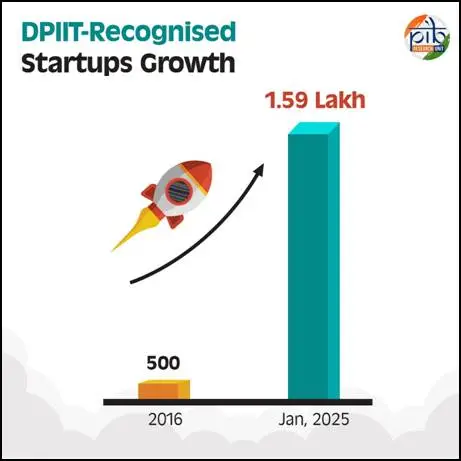
The Startup India initiative, launched in 2016, has reshaped India’s economic landscape, transforming it from a nation of job-seekers to one of job-creators. By fostering a dynamic innovation ecosystem, the program has propelled India to become the third-largest startup ecosystem globally, now home to over 118 “unicorns”—startups valued at over $1 billion.
How Startup India Transformed the Innovation Ecosystem 🚀
The initiative’s success lies in a multi-pronged strategy that has built a supportive environment for entrepreneurs from the ground up.
-
Building a Digital Foundation: The government created an “innovation stack” using digital public infrastructure like Aadhaar, UPI, and BharatNet. This foundation dramatically lowered the cost and barriers for startups to launch and scale their services, particularly in the fintech sector.
-
Providing Capital and Easing Regulations: Schemes like the Fund of Funds for Startups and the Credit Guarantee Scheme provided crucial early-stage capital. Simultaneously, reforms promoting Ease of Doing Business, such as single-window clearances, streamlined the approval process, saving time and money.
-
Fostering a Diverse and Booming Ecosystem: This supportive framework led to a surge in high-growth companies. The number of unicorns skyrocketed from just 4 in 2014 to 118 by mid-2025. The ecosystem has also diversified beyond traditional sectors into high-tech fields:
-
FinTech: UPI has made India a global leader in digital payments.
-
SpaceTech: Reforms have enabled over 300 private startups like Skyroot Aerospace to enter the space sector.
-
DefenceTech: Schemes like iDEX are helping over 600 startups contribute to India’s defence indigenisation.
-
-
Creating a “Startup Dividend”: The growth has had a significant economic impact, creating over 12 lakh direct jobs and millions of indirect ones. This has helped reduce import dependence and boost India’s global economic standing.
Key Challenges Facing Startups
Despite the remarkable growth, the ecosystem faces several significant hurdles that could slow its momentum.
-
Funding Disparity: Startups in Tier-II and Tier-III cities struggle to access the capital that is more readily available in major metropolitan hubs.
-
Regulatory Hurdles: A complex legal environment, including debates over the Motor Vehicles Act for cab aggregators and compliance with the Digital Personal Data Protection Act, can create significant administrative burdens.
-
High Failure Rate: A staggering 90% of startups fail within the first five years, often due to difficulties in scaling operations and entering new markets.
-
Market Saturation: Certain sectors, like EdTech, have become intensely competitive, leading to unsustainable business models and market consolidation.
The Way Forward: Strengthening the Ecosystem 💡
To sustain its growth trajectory, India’s startup ecosystem requires continued and strategic policy support.
-
Enhanced Financial Incentives: Extending tax benefits for startups from three to five years and offering special incentives for deep-tech companies can encourage long-term investment.
-
Guaranteed Market Access: Mandating that a certain percentage of government procurement comes from startups would create a stable and significant market for new companies.
-
Decentralization: Developing Tier-II and Tier-III cities as startup hubs through a “hub-and-spoke” model can distribute growth more evenly across the country.
-
Focused Skill Development: Expanding programs under Skill India to focus on emerging technologies like AI, blockchain, and IoT will create a workforce ready for the future.
In conclusion, the journey from “Startup India” to a “Unicorn Nation” signifies a fundamental shift in India’s confidence and ambition. By continuing to nurture this ecosystem through smart, supportive policies, India can solidify its position as a global leader in innovation.
UPSC Previous Year Question (PYQ)
Prelims
Q. What does venture capital mean? (2014)
(a) A short-term capital provided to industries
(b) A long-term start-up capital provided to new entrepreneurs
(c) Funds provided to industries at times of incurring losses
(d) Funds provided for replacement and renovation of industries
Ans: (b)
Mains
Q. Scientific research in Indian universities is declining, because a career in science is not as attractive as are business professions, engineering or administration, and the universities are becoming consumer-oriented. Critically comment. (2014)