
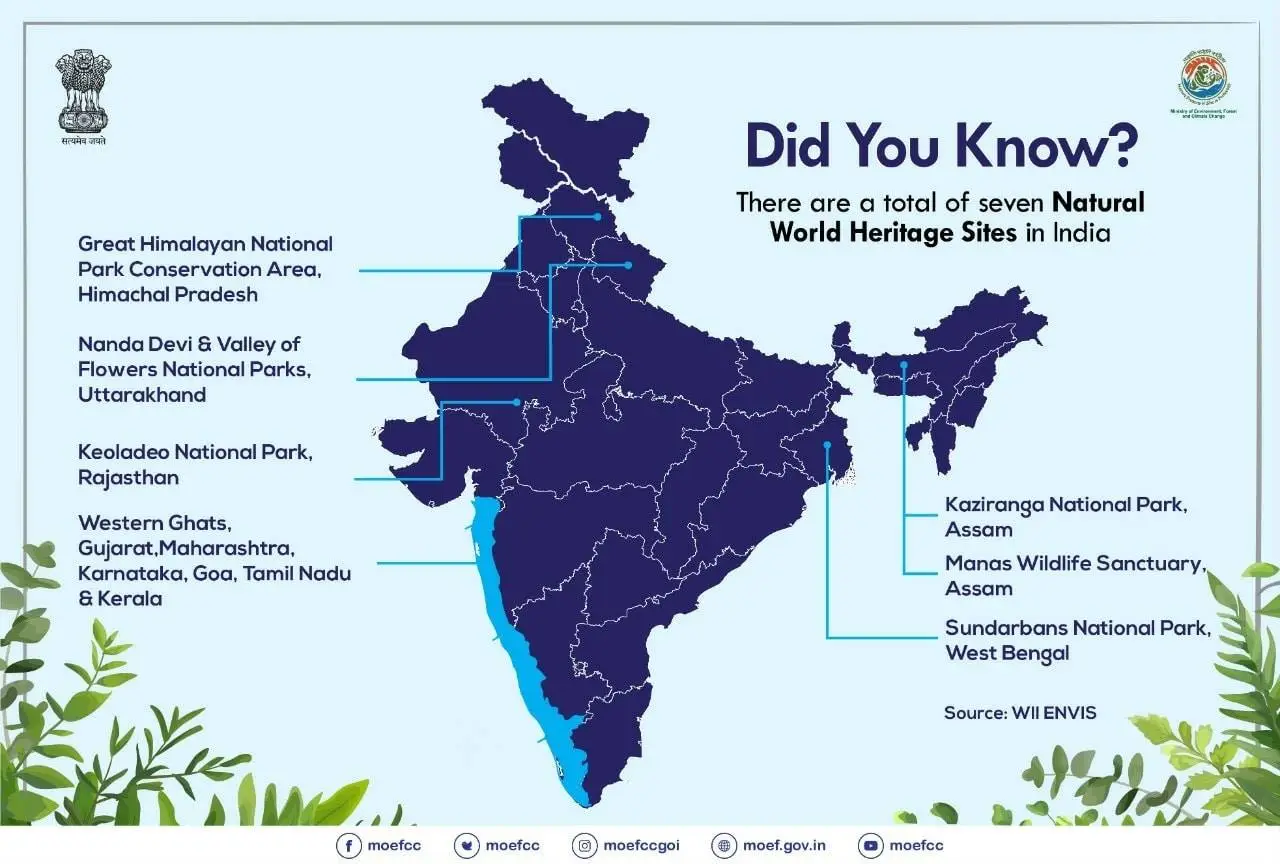
Recently, India has proposed seven new natural sites for inclusion in UNESCO’s Tentative List of World Heritage Sites (WHS). This development takes India’s total number of sites on the Tentative List to 69 (49 cultural, 17 natural, and 3 mixed), showcasing the nation’s immense geological and natural diversity.
Syllabus Relevance
-
Prelims: World Heritage Sites in India, Geographical Locations, Key Features of Natural Sites, UNESCO.
-
GS Paper 1 (Indian Heritage and Culture & Geography): Geographical features and their location, conservation of heritage.
-
GS Paper 3 (Environment & Conservation): Conservation of biodiversity and natural heritage, eco-tourism.
Understanding the World Heritage Nomination Process
Before analyzing the new sites, it’s essential to understand the key concepts involved in the UNESCO World Heritage designation.
1. What is a World Heritage Site (WHS)?
A World Heritage Site is a landmark or area legally protected by an international convention administered by UNESCO. These sites are designated for having Outstanding Universal Value (OUV), meaning they possess cultural, historical, scientific, or other forms of significance that are considered important for the collective interest of humanity. The list is maintained under the 1972 World Heritage Convention, which India ratified in 1977.
2. What is the Tentative List?
The Tentative List is a crucial first step in the nomination process.
-
Inventory of Sites: It is an inventory of properties that a country intends to consider for nomination in the future.
-
Mandatory Requirement: A site must be on the Tentative List for at least one year before it can be nominated for the final World Heritage List.
-
Nodal Agency in India: The Archaeological Survey of India (ASI) is responsible for compiling this list and submitting nominations to UNESCO.
Details of the 7 Newly Proposed Natural Sites 🏞️
These sites represent a wide range of India’s unique geological history and are prime candidates for future WHS status.
| Site Name | Location (State) | Key Geological / Ecological Feature |
| Deccan Traps of Panchgani & Mahabaleshwar | Maharashtra | Part of the massive Deccan Traps; showcases some of the world’s best-preserved basaltic lava flows. Already within the Koyna WLS (part of a WHS). |
| St. Mary’s Island Cluster | Karnataka | Known for its rare columnar basaltic rock formations from the Late Cretaceous period, formed during the volcanic activity linked to the separation of India from Madagascar. |
| Meghalayan Age Caves | Meghalaya | Features extensive cave systems. The Mawmluh Cave is the global stratotype for the Meghalayan Age of the Holocene Epoch, marking a significant global climate event. |
| Naga Hill Ophiolite | Nagaland | A rare exposure of ophiolite rocks, which represent a fragment of the ancient oceanic crust that has been uplifted onto the continental plate. |
| Erra Matti Dibbalu (Red Sand Hills) | Andhra Pradesh | Unique coastal red sand dune formations that serve as a paleo-environmental indicator, revealing past climatic and sea-level changes. A GSI Geo-Heritage Monument. |
| Natural Heritage of Tirumala Hills | Andhra Pradesh | Features two significant geological monuments: the Eparchaean Unconformity and the Silathoranam (Natural Arch), representing over 1.5 billion years of geological history. |
| Varkala Cliffs | Kerala | A unique coastal cliff formation exposing the Warkalli Formation (Mio-Pliocene age), significant for studying Cenozoic geological history. Also famous for its natural springs. |
Significance for India 🇮🇳
The inclusion of these sites on the Tentative List holds immense importance:
-
Boost to Geo-Tourism: It highlights India’s geological heritage, opening new avenues for scientific and educational tourism beyond traditional cultural sites.
-
Enhanced Conservation Efforts: Provides a framework for stronger legal and administrative protection for these ecologically and geologically sensitive areas.
-
Global Recognition: Elevates India’s status as a custodian of globally significant natural heritage and strengthens its soft power.
-
Spur to Research: Encourages further scientific study and research into the Earth’s history, tectonic processes, and climate change as evidenced by these sites.
-
Local Economic Growth: If inscribed as WHS, these sites can attract international tourism, leading to job creation and sustainable development for local communities.
Challenges and Way Forward
While inclusion on the Tentative List is a positive step, the journey to final inscription and effective management faces several challenges:
-
Development vs. Conservation: Balancing infrastructure development, mining, and urban expansion with the need to preserve the integrity of these sites.
-
Sustainable Tourism Model: The risk of overtourism can lead to environmental degradation. A well-regulated, low-impact tourism model is essential.
-
Community Participation: Ensuring that local communities are stakeholders in the conservation process and that the economic benefits of tourism flow back to them.
-
Technical and Financial Capacity: The final nomination dossier requires extensive scientific data and a robust management plan, which demands significant resources and expertise.
The way forward lies in creating comprehensive and inclusive site management plans, strengthening the capacity of local and state bodies, and fostering public awareness about the immense value of India’s natural and geological heritage.
UPSC PYQ
Prelims
Q. Consider the following properties included in the World Heritage List released by UNESCO: ( 2024)
Shantiniketan
Rani-ki-Vav
Sacred Ensembles of the Hoysalas
Mahabodhi Temple Complex at Bodhgaya
How many of the above properties were included in 2023?
(a) Only one
(b) Only two
(c) Only three
(d) All four
Ans: (b)
Mains:
Q.1 Safeguarding the Indian Art Heritage is the need of the moment. Discuss. (2018)
Q.2 Indian Philosophy and tradition played a significant role in conceiving and shaping the monuments and their art in India. Discuss. (2020)