
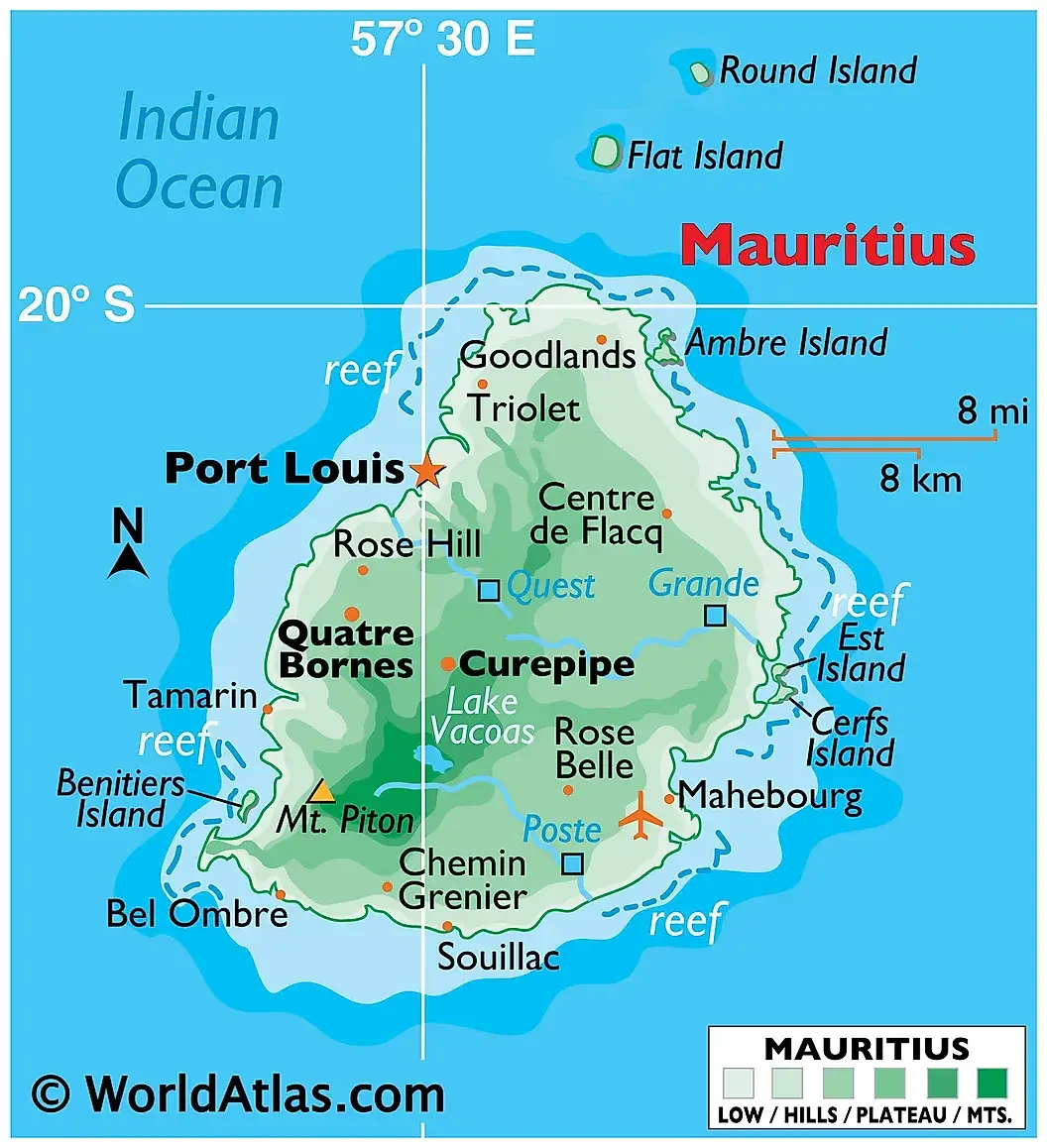
Introduction
The recent high-level visit of the Prime Minister of Mauritius to India has reaffirmed the deep-rooted, multifaceted, and strategic relationship between the two nations. Describing India as a ‘trusted partner’, the visit highlighted the time-tested nature of the ties, which are built on the foundations of shared cultural heritage, mutual respect, and a convergence of strategic interests in the Indian Ocean Region (IOR). The relationship is a cornerstone of India’s ‘Neighbourhood First’ policy and its vision of SAGAR (Security and Growth for All in the Region).
Key Outcomes of the Recent High-Level Engagement
The visit culminated in several agreements that aim to deepen cooperation across various sectors:
-
Economic and Development Cooperation:
-
A Special Economic Package was announced for Mauritius, targeting key infrastructure projects including the development of Port Louis.
-
The first Jan Aushadhi Kendra outside India was established in Mauritius, showcasing cooperation in affordable healthcare.
-
India will assist in setting up an AYUSH Centre of Excellence, promoting traditional medicine.
-
-
Community and Capacity Building:
-
An MoU for Phase 2 of the High Impact Community Development Projects (HICDPs) was signed.
-
India will support capacity building for the Mauritian civil service, using its Mission Karmayogi platform as a model.
-
-
Strategic and Technological Cooperation:
-
An MoU on Energy Cooperation was signed to enhance Mauritius’s energy security, including the development of a floating solar power plant.
-
An MoU on Space Cooperation will facilitate collaboration in satellite telemetry, remote sensing, and navigation, strengthening Mauritius’s technological capabilities.
-
Significance of the Bilateral Relationship
For India:
-
Strategic Gateway: Mauritius is central to India’s vision of MAHASAGAR (Maritime and Allied Holistic Advancement for Security and Growth for All in the Region). Its strategic location in the Western Indian Ocean is vital for securing sea lanes of communication (SLOCs) and conducting maritime surveillance.
-
Counterbalancing China: A strong partnership with Mauritius helps India counterbalance China’s growing strategic presence and investments in the IOR.
-
Economic Hub for Africa: Through the Comprehensive Economic Cooperation and Partnership Agreement (CECPA), Mauritius serves as a crucial gateway for Indian trade and investment into mainland Africa, especially given its membership in the African Continental Free Trade Area (AfCFTA).
For Mauritius:
-
Primary Development Partner: India has consistently been Mauritius’s foremost development partner, providing over in assistance over the last decade for critical infrastructure and social projects.
-
Net Security Provider: India plays a key role in protecting Mauritius’s vast Exclusive Economic Zone (EEZ) through joint patrolling, surveillance (e.g., at Agaléga Island), and capacity building of its coast guard.
-
First Responder in Crises: India has repeatedly acted as a first responder for Mauritius during crises, such as the Wakashio oil spill (2020), Cyclone Chido (2024), and the COVID-19 pandemic, providing essential supplies and technical assistance.
Pillars of India-Mauritius Relations
-
Political and Diplomatic:
-
Diplomatic relations were established in 1948, even before Mauritius’s independence.
-
The relationship was elevated to an Enhanced Strategic Partnership in 2025.
-
The CECPA (2021) is India’s first-ever trade agreement with an African nation.
-
-
Economic and Commercial:
-
Foreign Direct Investment (FDI): Mauritius has been a top source of FDI into India for decades, facilitated by the Double Taxation Avoidance Convention (DTAC). In FY 2023-24, it was the second-largest source after Singapore.
-
Trade: India is among the top three trading partners for Mauritius, with key Indian exports including petroleum products, pharmaceuticals, and cereals.
-
-
Cultural and People-to-People:
-
The Indian diaspora (nearly 70% of the population) forms the bedrock of the relationship.
-
India has extended Overseas Citizenship of India (OCI) eligibility to Mauritians with Indian ancestry up to seven generations.
-
Cultural institutions like the Mahatma Gandhi Institute, supported by India, play a pivotal role in preserving shared heritage.
-
Challenges in the Bilateral Relationship
-
Geopolitical Competition: Increasing Chinese investment in Mauritius, including the Jinfei Smart City, poses a challenge to India’s strategic influence. Mauritius must perform a delicate balancing act with major powers.
-
Over-reliance and Diversification: Mauritius’s significant reliance on Indian aid and credit lines could create dependencies, prompting it to diversify its international partnerships.
-
Limited Private Sector Engagement: The economic relationship is dominated by Public Sector Enterprises (PSEs). Low participation from India’s private sector limits opportunities for innovation and trade diversification.
-
Shared Maritime Threats: The Western Indian Ocean faces persistent threats from piracy, narcotics trafficking, and Illegal, Unreported, and Unregulated (IUU) fishing, which require continuous joint efforts.
Way Forward
To further strengthen this special relationship, the following steps are crucial:
-
Deepen Economic Integration: Expand the scope of CECPA to include services, fintech, and the digital economy. Promoting a Rupee–Mauritian Rupee payment system can further boost trade and investment.
-
Enhance Strategic and Maritime Cooperation: Bolster the strategic infrastructure on Agaléga Island and enhance joint surveillance and intelligence-sharing capabilities to secure the IOR and advance the MAHASAGAR vision.
-
Focus on the Blue Economy and Sustainability: Collaborate on climate adaptation, disaster management, and marine conservation to address threats like oil spills and coastal degradation, which are critical for Mauritius’s tourism-dependent economy.
-
Strengthen Financial and Regulatory Cooperation: Work together to enhance anti-money laundering frameworks, reinforcing Mauritius’s status as a clean and credible global financial hub.
-
Leverage Diaspora and Cultural Capital: Increase scholarships, expand the Indian Technical and Economic Cooperation (ITEC) programme, and establish a Pravasi Bharatiya Kendra to deepen engagement with the Indian diaspora.
Conclusion
The India-Mauritius relationship is a model of South-South cooperation, evolving from a partnership based on shared history to one driven by strategic convergence. By deepening economic ties, enhancing maritime security cooperation, and leveraging their strong people-to-people connections, both nations can navigate regional challenges and build a resilient and mutually beneficial future, reinforcing stability and prosperity in the Indian Ocean Region.
UPSC Civil Services Examination Previous Year Questions (PYQs)
Prelims:
Q. A great deal of Foreign Direct Investment (FDI) to India comes from Mauritius than from many major and mature economies like UK and France. Why? (2010)
(a) India has preference for certain countries as regards receiving FDI
(b) India has double taxation avoidance agreement with Mauritius
(c) Most citizens of Mauritius have ethnic identity with India and so they feel secure to invest in India
(d) Impending dangers of global climatic change prompt Mauritius to make huge investments in India.
Ans: (b)
Mains:
Q. Project ‘Mausam’ is considered a unique foreign policy initiative of Indian government to improve relationships with its neighbours. Does the project have a strategic dimension? Discuss. (2015)