
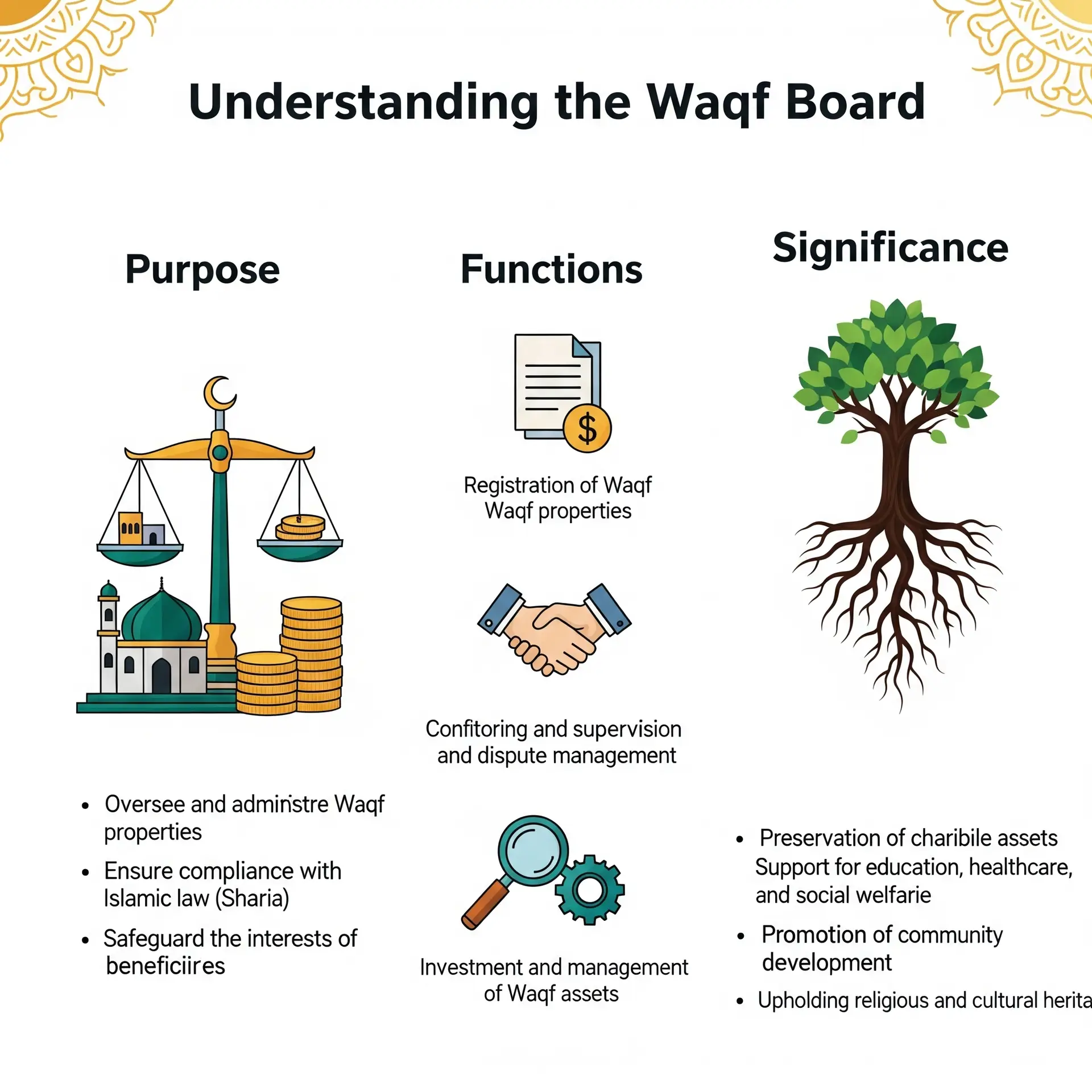
The Supreme Court (SC) has intervened in the Waqf (Amendment) Act, 2025, staying certain contentious provisions while upholding others. The core of the issue revolves around balancing administrative reforms of Waqf properties with the constitutional safeguards for religious denominations under Article 26 (freedom to manage religious affairs).
Key Contentious Provisions and the Supreme Court’s Stance
The Supreme Court’s interim order differentiates between provisions aimed at genuine administrative reform and those perceived as infringing upon fundamental rights.
Provisions Stayed by the Supreme Court
The Court has put a hold on provisions that it found to be prima facie arbitrary or violative of constitutional principles.
-
Five-Year Rule for Practising Muslims: The amendment stipulated that a person must have been a practising Muslim for at least five years to create a waqf.
-
SC’s Rationale: This provision was stayed because there is no clear or objective mechanism to verify the duration of an individual’s religious practice. The Court deemed it unworkable until the government frames specific rules.
-
-
Arbitrary Powers for District Collectors (Section 3C): The Act empowered District Collectors to declare a property as government-owned during an inquiry, stripping it of its Waqf status for the duration of the investigation.
-
SC’s Rationale: The Court found this to be a violation of the separation of powers. It ruled that disputes over property titles must be adjudicated by judicial bodies like Waqf Tribunals or courts, not by administrative officers. It directed that during an inquiry, the status of Waqf properties must be maintained, and no third-party rights can be created.
-
-
Non-Muslim Representation in Waqf Boards: The amendment allowed for a potentially large number of non-Muslim members on Waqf boards.
-
SC’s Rationale: Citing the need to protect the autonomy of a religious denomination under Article 26, the Court read down the provision by capping non-Muslim representation.
-
Central Waqf Council: Maximum of 4 non-Muslims in the 22-member council.
-
State Waqf Boards: Maximum of 3 non-Muslims in the 11-member boards.
-
-
Provisions Upheld by the Supreme Court
The Court allowed certain provisions to stand, viewing them as necessary reforms to ensure transparency and prevent misuse.
-
Applicability of the Limitation Act, 1963: The original Waqf Act, 1995, exempted Waqf properties from the Limitation Act, allowing legal action against encroachment at any time. The 2025 amendment removes this exemption.
-
SC’s Rationale: The Court upheld this change to ensure uniformity in law and correct what it viewed as a discriminatory provision that gave Waqf properties an indefinite right to litigate, unlike other entities.
-
-
Abolition of “Waqf by Use”: The amendment scraps the concept where a property could be deemed Waqf simply due to long-term use for religious or charitable purposes, even without formal dedication.
-
SC’s Rationale: The Court found no prima facie reason to stay this, acknowledging arguments that this concept was being misused to encroach upon public and private lands.
-
Constitutional and Judicial Context: Religious Freedom ⚖️
The Supreme Court’s decision is grounded in a long history of jurisprudence balancing state regulation with religious freedom under Articles 25 and 26. Key precedents include:
-
Bijoe Emmanuel v. State of Kerala (1987): Established that the right to freedom of religion includes the right to refuse participation in acts (like singing the national anthem) that violate one’s sincere religious beliefs, provided it doesn’t disrupt public order.
-
Shayara Bano v. Union of India (2017): The Court struck down instant triple talaq, holding that a practice must be an essential part of a religion to be protected under Article 25. It differentiated religious law from practices that violate fundamental rights like equality (Article 14).
-
Dr. Mahesh Vijay Bedekar v. Maharashtra (2016): The Court clarified that not all practices associated with religion are “essential.” It held that the use of loudspeakers for prayers is not an essential religious practice and therefore not a fundamental right under Article 25 or Article 19(1)(a).
Conclusion
The Supreme Court’s interim order on the Waqf (Amendment) Act, 2025, reflects a nuanced approach. It seeks to balance necessary administrative reforms with the protection of the constitutional autonomy of religious communities. By staying provisions that grant excessive administrative power and upholding those that promote legal uniformity, the Court has reinforced the principle of constitutional scrutiny. The final judgment will be crucial in defining the boundaries between state regulation and the freedom to manage religious affairs in India.
UPSC Mains
Q. How is the Indian concept of secularism different from the western model of secularism? Discuss. (2018)