
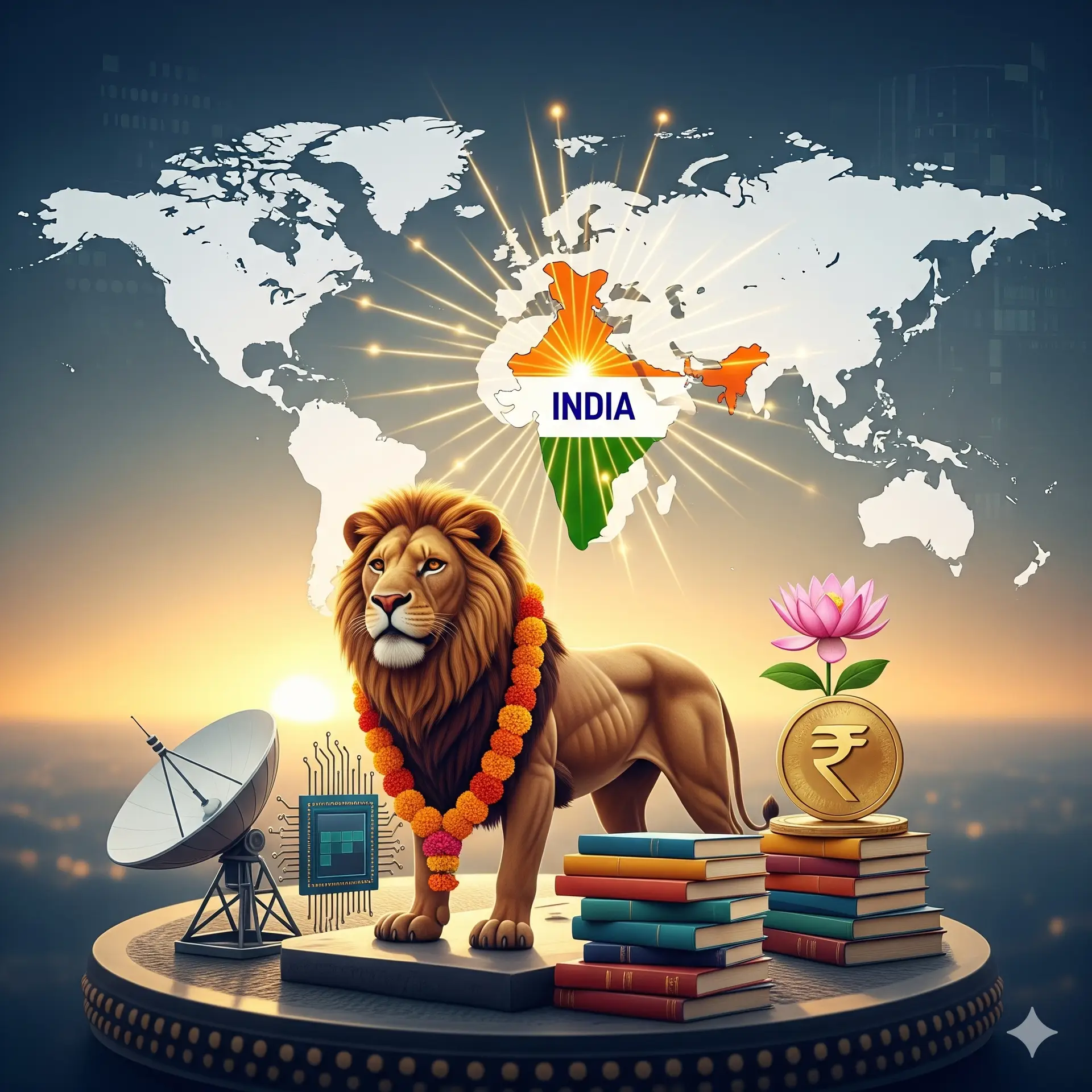
As the world’s fastest-growing major economy, India’s aspiration to become a leading global power is a subject of intense debate. While its economic rise and demographic potential are undeniable, a realistic assessment reveals significant constraints that temper its ambitions. A balanced analysis of India’s foundational strengths against its structural weaknesses is crucial to understanding its trajectory in the evolving global order.
Constraints Hindering India’s Global Power Aspirations
Several key challenges impede India’s ability to translate its potential into global influence.
-
The Gap Between Ambition and Strategic Capacity: There is a discernible gap between India’s great power ambitions and its institutional capacity to project power.
-
Military Modernization: India’s military expenditure (USD 86 billion in 2024) is significantly lower than that of China (USD 314 billion), limiting its power projection capabilities.1 Its status as one of the world’s largest arms importers underscores its dependence and underdeveloped indigenous defence industry.
-
Economic Vulnerabilities: Critical sectors like electronics and energy remain dependent on global supply chains, exposing India to geopolitical shocks.2
-
-
Economic Paradox and Human Development Deficits:
-
While India is the world’s 4th largest economy, its low per capita GDP (USD 2,711) places it in the lower-middle-income bracket and limits its economic leverage in global diplomacy.
-
A low rank of 130 out of 193 on the Human Development Index (HDI), coupled with high inequality, indicates that the benefits of growth are not uniformly distributed. This constrains the development of a skilled workforce and a healthy populace, which are prerequisites for national power.
-
-
The Dilemma of ‘Strategic Autonomy’: India’s foreign policy, characterized by strategic autonomy and multi-alignment (balancing engagement with forums like the Quad and the SCO), allows for diplomatic flexibility. However, critics argue this approach can be perceived as ambiguity, potentially undermining its credibility as a reliable partner during international crises.
-
Technological and Innovation Gaps: Despite successes in digital public infrastructure like UPI, India lags in cutting-edge technology. Its rank of 39th on the Global Innovation Index 2024 (compared to China’s 11th) highlights the need for greater investment in strategic sectors like semiconductors, quantum computing, and biotechnology.3
-
Internal Social Fault Lines: Significant regional disparities in development, social cohesion challenges, and concerns highlighted by indices like the World Press Freedom Index (ranked 159/180) can impact India’s soft power and democratic credibility on the global stage.
Foundations Supporting India’s Rise
Despite the constraints, India’s aspirations are built on several strong pillars.
-
Economic Momentum and Demographic Dividend: A sustained high growth rate (projected at 6-7%) is set to make India the world’s third-largest economy by 2030. Its young population, with a median age of 28.2, represents a massive demographic dividend that can drive innovation and consumption.4
-
Geostrategic Significance: Located at the heart of the Indian Ocean, India is central to global maritime trade.5 Its active role in diverse platforms like the Quad, SCO, and BRICS allows it to act as a diplomatic bridge and a key stakeholder in Indo-Pacific security.
-
Growing Technological and Military Capabilities: India is an emerging digital powerhouse with a thriving startup ecosystem.6 Successes in its space program (Chandrayaan-3) and advancements in indigenous defence platforms (Tejas fighter jet, INS Arihant submarine) showcase its growing technological prowess.7
-
Soft Power and a Unique Diplomatic Voice: India’s large and influential diaspora, rich cultural heritage (yoga, cinema), and its consistent advocacy for the Global South amplify its soft power. Its doctrine of strategic autonomy allows it to be a leading voice for a multipolar world order.
The Way Forward: Navigating Global Dynamics
To realize its potential, India must adopt a calibrated strategy:
-
Strengthen Domestic Foundations: The foremost priority must be to address internal weaknesses. Investing in human capital (health, education), bridging regional inequalities, and undertaking deep institutional reforms are essential to convert the demographic potential into a tangible dividend.8
-
Pursue Calibrated Foreign Policy: Continue the policy of multi-alignment, building issue-based coalitions rather than entering rigid alliances. This allows India to maintain flexibility while pursuing its national interests with diverse partners.
-
Leverage Niche Strengths: India should focus on amplifying its influence in areas of comparative advantage, such as digital innovation, tech diplomacy, and soft power, to shape global norms and standards.
-
Craft a Strategic Narrative: India must clearly articulate its vision as a “leading power” that champions a democratic, inclusive, and rules-based global order, guided by its civilisational ethos of ‘Vasudhaiva Kutumbakam’ (the world is one family).9
Conclusion
India’s journey towards becoming a great power is an evolutionary process, not an event. It is not about imitating the trajectory of the US or China but about forging a unique path based on its domestic strengths and civilisational values. While significant challenges remain, its strong foundational pillars position India not merely as a “balancing power” but as a potential “leading power” capable of shaping the contours of an emerging multipolar world.
UPSC PYQs
Q. “With the waning of globalization, the post-Cold War world is becoming a site of sovereign nationalism.” Elucidate. (2025)
Q. At the international level, bilateral relations between most nations are governed on the policy of promoting one’s own national interest without any regard for the interest of other nations. This leads to conflicts and tension between nations. How can ethical consideration help resolve such tensions? Discuss with specific examples. (2015)
Q. ‘The long-sustained image of India as a leader of the oppressed and marginalised nations has disappeared on account of its new found role in the emerging global order.’ Elaborate. (2019)